When the combined NASA/USAF/Lockheed Martin team built the F-16 Auto GCAS system, we had one goal: to save pilots' lives. Auto GCAS has been credited with saving dozens of aircraft and pilots.
IO Aero's mission is to move these technologies into the public domain and create systems that not only make aviation much safer, but also make flying much easier and more approachable.
IO Aero's mission is to move these technologies into the public domain and create systems that not only make aviation much safer, but also make flying much easier and more approachable.IO Aero's mission is to move these technologies into the public domain and create systems that not only make aviation much safer, but also make flying much easier and more approachable.
Not where the aircraft is. Where it can safely go next.
IO Intelligence is our autonomy line, built on the IO AVA core. In development with partners. Not for sale.
IO Intelligence


In development
Assured autonomy for drones and aircraft.
IO Intelligence is our autonomy line, built on the IO AVA (Assured Vehicle Autonomy) core. Autonomy gives an aircraft the ability to understand its situation, choose what to do next, fly the decision, and keep adjusting as the world changes. It is in development and not available to buy. Today we build it with a small number of partners.
Plan
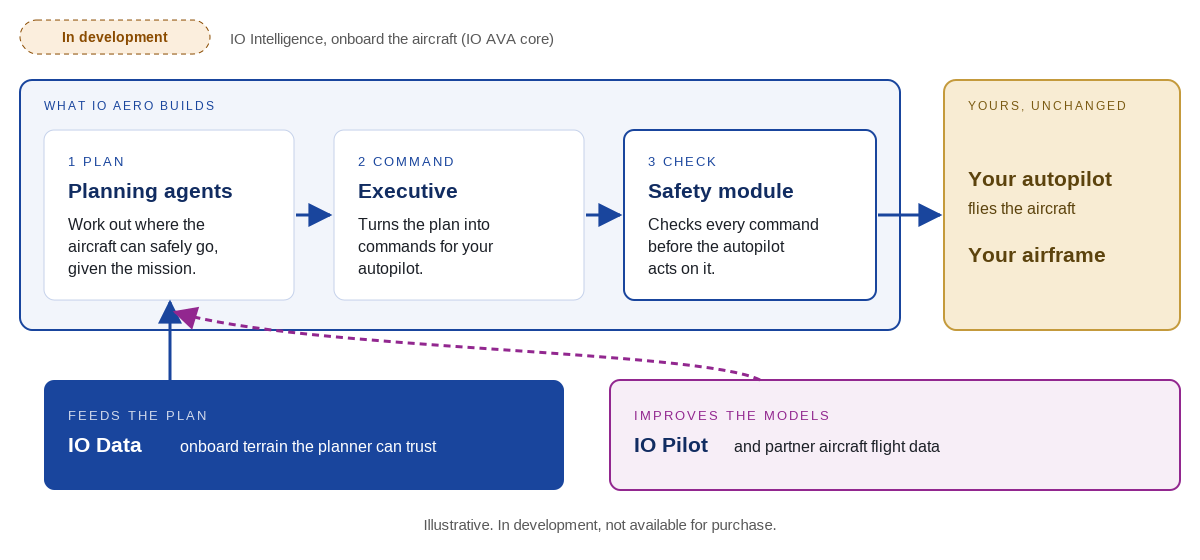
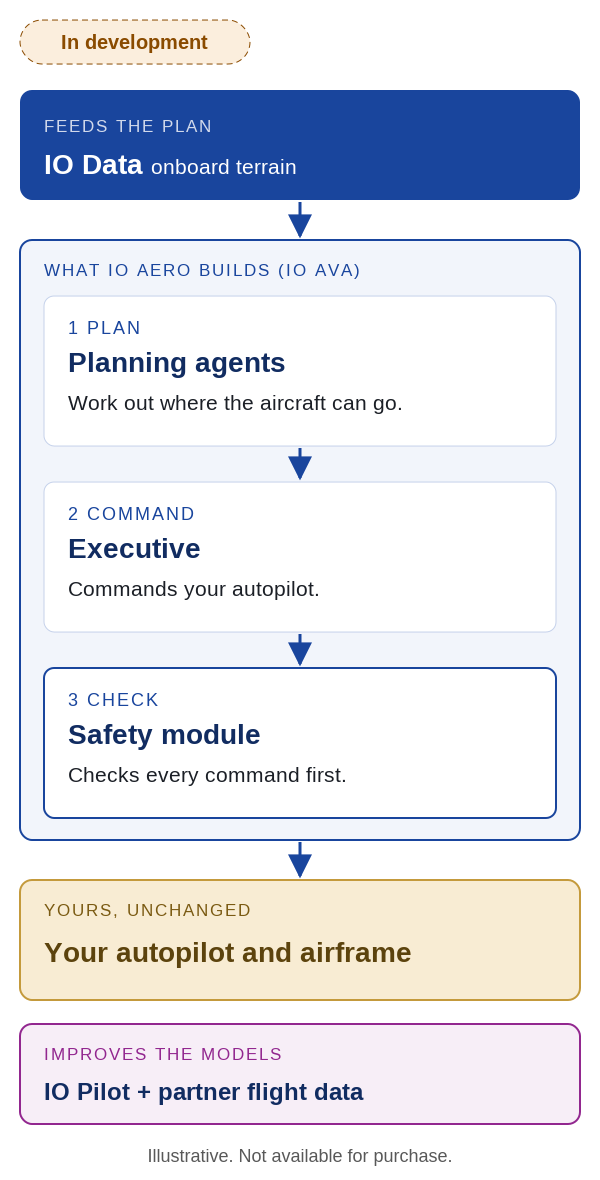
Planning agents work out where the aircraft can safely go next, given terrain, energy and the mission.
Command
An executive layer turns the chosen plan into commands for the aircraft's existing autopilot.
Check
A safety module checks every command before the autopilot acts on it.
01 Perceive
Understand the aircraft, the environment and the mission.
02 Decide
Choose the next action based on priorities, opportunities and limits.
03 Act
Turn the decision into precise, purposeful aircraft motion.
04 Adapt
Reassess continuously as conditions, information or objectives change.
How it will work
How it fits together
Five roles, one coordinated system.
Mission planning sets the intent: goals, priorities and constraints. Five components turn that intent into aircraft action. This is not waypoint following. The aircraft keeps deciding what to do next.
Behavior Executive
Decide what to do. Selects and supervises the behavior that meets the mission intent, and decides when to continue, interrupt or replan.
Trajectory Planner
Choose how to move. Compares candidate trajectories against aircraft capability, wind and constraints, then picks the path, timing and profile.
Maneuver Executive
Manage execution. Runs each maneuver phase and turns the chosen trajectory into course, airspeed and vertical targets.
Safety Assurance
Keep commands safe. Checks every proposed command. Passes it, limits it, or replaces it with a recovery command.
Flight Control System
Fly the aircraft. The aircraft's own autopilot tracks the permitted targets and reports back.
Aircraft state, wind, traffic and health feed back into every step, so the system can continue, replan or recover. IO Data supplies the terrain.
Conceptual architecture. In development.
Why the order matters
None of this works without the layer underneath it.
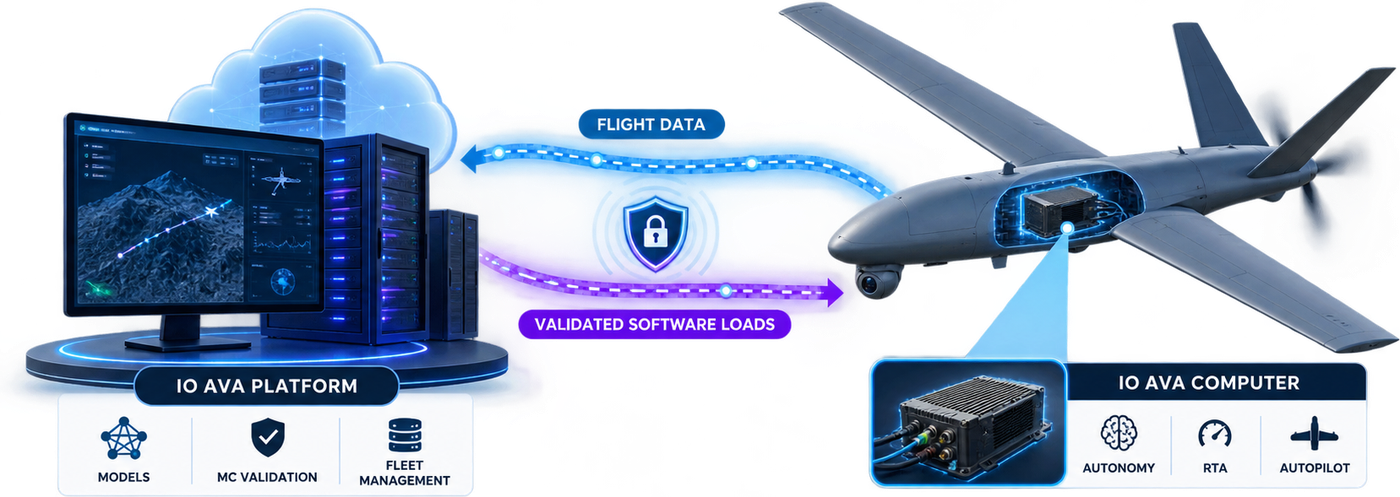
Deciding where an aircraft can safely go is only as good as the data it can hold in memory and query in real time. That is why IO Data came first, and why it is the part we sell today.
IO Data
Available now
Terrain, plus US runways and obstacles. Free developer pack, region packages, Enterprise.
Compressed terrain and aviation data. US and Canada package, Enterprise; free developer pack coming soon.
IO Pilot
On the App Store
Aviate AX1 for iPad and iPhone.
IO Intelligence
In development
Partner programs only. Not for sale.
“IO Aero’s mission is to bring that same life-saving intelligence into the future of aviation.”
Loyd Hook, CEO · Our team
Building an aircraft that needs autonomy?
We talk with drone builders, program offices and integrators about partner programs.
IO Intelligence is in development. Nothing on this page is available for purchase.

“IO Aero’s mission is to bring that same life-saving intelligence into the future of aviation.”
Loyd Hook, CEO
Let’s get on comms
It all starts with a conversation. Whether you are a pilot, a government and defense representative, a technology partner or an investor, our comms are open.

Insights from the field
Learn about what IO-Aero is working on, and what we are learning along the way.


